

Page top

Lead Contents

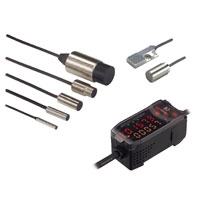
Smart Sensors (Inductive Displacement Type)

ZX-E

ZX-E

Smart Sensors that Use the Eddy Current Method Are Now Available

Primary Contents


Sensor Heads

ModelZX-EDR5TZX-ED01TZX-ED02T/
EM02T
ZX-EM07MTZX-EV04TZX-EM02H
Measurement range0 to 0.5 mm0 to 1 mm0 to 2 mm0 to 7 mm0 to 4 mm0 to 2 mm
Sensing objectMagnetic metals (Measurement ranges and linearities are different for non-magnetic metals. Refer to Engineering Data on See Engineering Data (Typical).)
Standard reference object18×18×3 mm30×30×3 mm60×60×3 mm45×45×3 mm
Material: ferrous (S50C)
Resolution *11 μm
Linearity *2± 0.5% F.S.± 1.0% F.S. *5
Linear output rangeSame as measurement range.
Temperature characteristic *3
(including Amplifier Unit)
0.15 % F.S./°C0.07% F.S./°C0.1% F.S./°C
Ambient
temperature
Operating *40 to 50°C
(with no icing
or
condensation)
-10 to 60°C (with no icing or condensation)-10 to 200°C
Storage *4-20 to 70°C (with no icing or condensation)-20 to 200°C
Ambient humidityOperating and storage: 35% to 85% (with no condensation)
Insulation resistance50 MΩ min. (at 500 DC)
Dielectric strength1,000 VAC, 50/60 Hz for 1 min between charged parts and case
Vibration resistance (destruction)10 to 55 Hz with 1.5-mm double amplitude for 2 h each in X, Y, and Z directions
Shock resistance (destruction)500 m/s2, 3 times each in X, Y, and Z directions
Degree of protection
(Sensor Head)
IEC60529,
IP65
IEC60529, IP67IEC60529,
IP60 *6
Connection methodConnector relay (standard cable length: 2 m)
Weight (packed state)Approx. 120 gApprox. 140 gApprox. 160 gApprox. 130 gApprox. 160 g
MaterialsSensor
Head
CaseBrassStainless steelBrassZinc
(nickel-plated)
Brass
Sensing
surface
Heat-resistant ABSPEEK
Tightening
nut
---Brass (nickel-plated)
(except ZX-ED02T)
---Brass
(nickel-plated)
Toothed
washer
---Iron (zinc-plated)
(except ZX-ED02T)
---Iron
(zinc-plated)
PreamplifierPES
AccessoriesAmplifier Mounting Brackets (ZX-XBE1), Instruction Manual

*1.Resolution: The resolution is the deviation (±3σ) in the linear output when connected to the ZX-EDA Amplifier Unit. The above values indicate the deviations observed 30 minutes after the power is turned ON.
(The resolution is measured with OMRON's standard reference object at 1/2 of the measurement range with the ZX-EDA set for the maximum average count of 4,096 per period.)
The resolution is given at the repeat accuracy for a stationary workpiece, and is not an indication of the distance accuracy. The resolution may be adversely affected under strong electromagnetic fields.

*2.Linearity: The linearity is given as the error in an ideal straight line displacement output when measuring the standard reference object. The linearity and measurement values vary with the object being measured.

*3.Temperature characteristic: The temperature characteristic is measured with OMRON's standard reference object at 1/2 of the measurement range.

*4.The ambient temperature given is only for the sensor head. It is -10 to 60°C for the preamp.

*5.The value given is for an ambient temperature of 25°C.Do not use in moist environments because the case is not waterproof.

*6.Do not use in moist environments because the case is not waterproof.

Amplifier Units

ModelZX-EDA11ZX-EDA41
Measurement
period *1
150 μs
Possible average
count settings
1, 2, 4, 8, 16, 32, 64, 128, 256, 512, 1,024, 2,048, or 4,096
Linear output *2Current output: 4 to 20 mA/F.S., Max. load resistance: 300 Ω
Voltage output: ± 4 V ( ± 5 V, 1 to 5 V *3), Output impedance: 100 Ω
Judgement outputs
(3 outputs:
HIGH/PASS/LOW)
NPN open-collector outputs, 30 VDC, 50 mA max.
Residual voltage: 1.2 V max.
PNP open-collector outputs, 30 VDC, 50 mA max.
Residual voltage: 2 V max.
Zero reset input,
timing input,
reset input,
judgement output
hold input
ON: Short-circuited with 0-V terminal or 1.5 V or less
OFF: Open (leakage current: 0.1 mA max.)
ON: Supply voltage short-circuited or supply voltage within 1.5 V
OFF: Open (leakage current: 0.1 mA max.)
Function- Number of display digit changes - Sample hold - Peak hold
- Bottom hold, peak-to-peak hold - Self-peak hold - Self-bottom hold
- Average hold - Delay hold - Zero reset
- Initial reset - Linearity initialization - ON-delay timer
- OFF-delay timer - One-shot timer - Previous value comparison
- Non-measurement setting - Direct threshold value setting - Position teaching
- Automatic teaching - Hysteresis width setting - Timing inputs
- Reset input - Judgement output hold input - Monitor focus
- Linear output correction - (A-B) calculations *4 - (A+B) calculations *4
- K-(A+B) calculation *4 - Mutual interference prevention *4
- Sensor disconnection detection - Zero reset memory - Zero reset indicator
- Key lock
IndicationsJudgement indicators: High (orange), pass (green), low (yellow), 7-segment main digital display (red), 7-segment sub-digital display (yellow), power ON (green), zero reset (green), enable (green)
Voltage influence
(including Sensor)
0.5% F.S. of linear output value at ±20% of power supply voltage
Power supply
voltage
12 to 24 VDC ± 10%, Ripple (p-p): 10% max.
Current
consumption
140 mA max. with power supply voltage of 24 VDC (with Sensor connected)
Ambient
temperature
Operating and storage: 0 to 50°C (with no icing or condensation)
Ambient humidityOperating and storage: 35% to 85% (with no condensation)
Insulation
resistance
20 MΩ min. (at 500 DC)
Dielectric strength1,000 VAC, 50/60 Hz for 1 min
Vibration resistance
(destruction)
10 to 150 Hz with 0.7-mm double amplitude for 80 min each in X, Y, and Z directions
Shock resistance
(destruction)
300 m/s2, 3 times each in 6 directions (up, down, left, right, forward, backward)
Connection methodPrewired (standard cable length: 2 m)
Weight
(packed state)
Approx. 350 g
MaterialsCase: PBT (polybutylene terephthalate), Cover: Polycarbonate
AccessoriesInstruction Manual

*1.The response time for the first linear output or judgment output is calculated as follows (with fixed sensitivity): Measurement period × (Average count setting + 1). The response time for the second and later outputs is the measurement period specified in the table.

*2.The output can be switched between a current output and voltage output using a switch on the bottom of the Amplifier Unit.

*3.Setting is possible via the monitor focus function.

*4.A Calculating Unit (ZX-CAL2) is required.

Caution: In the interenst of product improvement, specifications are subject to change without notice.