

Page top

Lead Contents

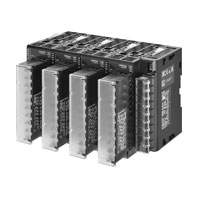
Modular Temperature Controller

EJ1

EJ1

In-panel Temperature Controller with Flexible Modular Design and Wide Integration with Host Devices

Primary Contents


Basic Unit/EJ1N-TC

Ratings

TypeEJ1N-TC4EJ1N-TC2
Power supply voltage24 VDC
Operating voltage range85% to 110% of rated voltage
Power consumption5 W max. (at maximum load)4 W max. (at maximum load)
Input *Thermocouple: K, J, T, E, L, U, N, R, S, B, W, PLII
ES1B Infrared Thermosensor: 10 to 70°C, 60 to 120°C, 115 to 165°C, 140 to 260°C
Analog input: 4 to 20 mA, 0 to 20 mA, 1 to 5 V, 0 to 5 V, 0 to 10 V
Platinum resistance thermometer: Pt100, JPt100
Input impedanceCurrent input: 150 Ω max., voltage input: 1 MΩ min.
Control
outputs
Voltage outputOutput voltage: 12 VDC ±15%, max. load current: 21 mA (PNP models with short-circuit
protection circuit)
Transistor
output
---Max. operating voltage: 30 V, max. load current: 100 mA
Current output---Current output range: 4 to 20 mA or 0 to 20 mA DC
Load: 500 Ω max. (including transfer output)
(Resolution: Approx. 2,800 for 4 to 20 mA DC,
approx. 3,500 for 0 to 20 mA DC)
Event
inputs
Input points---2
Contact input---ON: 1 kΩ max., OFF: 100 kΩ min.
Non-contact
input
---ON: Residual voltage: 1.5 V max.,
OFF: Leakage current: 0.1 mA max.
Event inputs---Outflow current: Approx. 4 mA per point
Number of input and
control points
Input points: 4, Control points: 4Input points: 2, Control points: 2
Setting methodVia communications
Control methodON/OFF control or 2-PID (with autotuning, self-tuning) (V1.2)
Other functionsTwo-point input shift, digital input filter, remote SP, SP ramp, manual manipulated variable,
manipulated variable limiter, interference overshoot adjustment, loop burnout alarm,
RUN/STOP, banks, I/O allocations, etc.
Ambient
temperature range
Operating: -10°C to 55°C, Storage: -25°C to 65°C (with no icing or condensation)
Ambient humidity rangeOperating: 25% to 85% (with no condensation)

*Inputs are fully universal. Therefore, platinum resistance thermometer, thermocouple, infrared thermosensor, and analog input can be
selected.

Characteristics

Indication accuracyThermocouple input/platinum resistance thermometer input:
(±0.5% of indication value (PV) or ±1°C, whichever is greater) ±1 digit max. *1
Analog input: ±0.5% FS ±1 digit max.
CT input: ±5% FS ±1 digit max.
Hysteresis0.1 to 999.9 EU (in units of 0.1 EU) *2
Proportional band (P)0.1 to 999.9 EU (in units of 0.1 EU) *2
Integral time (I)0 to 3,999 s (in units of 1 s)
Derivative time (D)0.0 to 999.9 s (in units of 0.1 s)
Control period0.5 s, 1 to 99 s (in units of 1 s)
Manual reset value0.0% to 100.0% (in units of 0.1%)
Alarm setting range-1,999 to 9,999 (decimal point position depends on input type)
Sampling period250 ms
Influence of signal
source resistance
Thermocouple: 0.1°C (0.2°F)/Ω max. (100 Ω max per line) *3
Platinum resistance thermometer: 0.4°C (0.8°F)/Ω max. (10 Ω max per line)
Insulation resistance20 MΩ min. (at 500 VDC)
Dielectric strength600 VAC, 50/60 Hz for 1 min between current-carrying terminals of different polarity
Vibration resistance10 to 55 Hz, 20 m/s2 for 2 hours each in X, Y, and Z directions
Shock resistance150 m/s2, 3 times each in 6 directions
Weight180 g
Degree of protectionRear case: IP20, Terminal section: IP00
Memory protectionEEPROM (non-volatile memory) (number of writes: 100,000)
StandardsApproved
standards
UL61010C-1, CSA C22.2 No.1010-1
Conformed
standards
EN61010-1 (IEC61010-1): Pollution level 2, overvoltage category II
EMC DirectiveEMI: EN61326
EMI Radiated: EN55011 Group1 class A
EMI Conducted: EN55011 Group1 class A
EMS: EN61326
ESD Immunity: EN61000-4-2
Electromagnetic Field Immunity: EN61000-4-3
Burst immunity/Noise Immunity: EN61000-4-4
Conducted Disturbance Immunity: EN61000-4-6
Surge Immunity: EN61000-4-5

*1.The indication of K thermocouples in the −200 to 1,300°C range, T and N thermocouples at a temperature of −100°C or less, and U and L thermocouples at any temperature is ±2°C ±1 digit maximum. The indication of B thermocouples at a temperature of 400°C or less is unrestricted. The indication of R and S thermocouples at a temperature of 200°C or less is ±3°C ±1 digit max.
W = (±0.5% of indication value (PV) or ±3°C, whichever is greater) ±1 digit max. PLII = (±0.5% of indication value (PV) or ±2°C, whichever is greater) ±1 digit max.
The indication accuracy for K thermocouples in the -199.9 to 999.9°C range "V1.2" is (±0.5% of indication value (PV) or ±1°C, whichever is greater) ±10 digit maximum. However, at a temperature of -100°C or less, it is ±2°C ±10 digit maximum.

*2."EU" stands for Engineering Unit. The location of the decimal point depends on the type of sensor that is selected.
If the decimal point locations is set to 0 (****), however, it will be treated as if it were set to 1 (***.*).

*3.B, R, S, and W sensors: 0.2°C/Ω max. (100 Ω max.)

Communications Specifications

ItemPort B *1Port A Terminal/
Port A Connector *1
G3ZA Connection Port *2
Transmission path
connection
RS-485 (multipoint)
Communications
method
RS-485 (two-wire, half duplex)
Synchronization
method
Start-stop synchronization
Communications
protocol
CompoWay/F, Modbus *4 (V1.1)CompoWay/F
Baud rate9.6, 19.2, 38.4, 57.6, or
115.2 kbps
38.4 kbps fixed57.6 kbps fixed
Transmission codeCompoWay/F: ASCII,
Modbus: RTU
CompoWay/F: ASCII
Data bit length7 or 8 bits7 bits
Stop bit length1 or 2 bits2 bits
Error detectionVertical parity
(none, even, or odd)
Vertical parity (even)
Block check character (BCC): with CompoWay/F, CRC-16: (with Modbus)
Flow controlNone
InterfaceRS-485
Retry functionNone
Communications
response wait time
0 to 99 ms (default: 5 ms)
(V1.1)
1 to 99 ms (default: 1 ms)---
Number of Units that
can be connected in
parallel *3
64 Units (model numbers
with TC4: 256 channels,
model numbers with TC2:
128 channels)
Communications
connection via port B on
the End Unit
64 Units (model numbers
with TC4: 256 channels,
model numbers with TC2:
128 channels)
Communications
connection via port A on
the End Unit
8 Units (Communications
connection via G3ZA port
on the Basic Unit)

*1.Connection from the EJ1C-EDU. When using an HFU, port B on the End Unit can be used for distributed placement only.

*2.A special cable (EJ1C-CBLA050) must be purchased separately for the G3ZA connection.

*3.For the number of Units that can be connected, refer to Data Sheet.

*4.The Modbus protocol can be used with Basic Unit with version 1.1 or higher.

Current Transformer (CT) Rating

Dielectric strength1,000 VAC for 1 min
Vibration resistance50 Hz, 98 m/s2
WeightE54-CT1: Approx. 11.5 g, E54-CT3: Approx. 50 g
Accessories
(E54-CT3 only)
Armatures (2), plugs (2)

Characteristics of the Heater Burnout Alarm, SSR Failure Alarm, and Heater Overcurrent Alarm (TC2[]-QNHB Model Only)

Maximum heater current100 VAC
Input current indication accuracy±5%FS ±1 digit max.
Heater burnout alarm setting range0.1 to 99.9 A (in units of 0.1 A)
0.0 A: Heater burnout alarm output turns OFF.
100.0 A: Heater burnout alarm output turns ON.
Min. detection ON time: 100 ms *1
SSR failure alarm setting range0.1 to 99.9 A (in units of 0.1 A)
0.0 A: SSR failure alarm output turns ON.
100.0 A: SSR alarm output turns OFF.
Min. detection OFF time: 100 ms *2
Heater overcurrent alarm setting range0.1 to 99.9 A (in units of 0.1 A)
0.0 A: Heater overcurrent alarm output turns ON.
100.0 A: Heater overcurrent alarm output turns OFF.
Min. detection ON time: 100 ms *1

*1.When the control output ON time is less than 100 ms, heater burnout detection, heater overcurrent detection, and heater current measurement are not performed.

*2.When the control output OFF time is less than 100 ms, SSR failure alarm and leakage current measurement are not performed.

Input Ranges

Sensor inputs are fully universal. Therefore, platinum resistance thermometer, thermocouple, infrared thermosensor, and analog input can be selected.
Inputs can be set for each channel using universal inputs.

EJ1_Spec6
EJ1_Spec7

Applicable standards by input type are as follows:
K, J, T, E, N, R, S, B: JIS C1602-1995, IEC584-1
L: Fe-CuNi, DIN 43710-1985
U: Cu-CuNi, DIN 43710-1985
W: W5Re/W26Re, ASTM E988-1990
PL II: According to Platinel II Electromotive Force Table by Engelhard Corp.
JPt100: JIS C 1604-1989, JIS C 1606-1989
Pt100: JIS C 1604-1997 IEC 751

HFU Unit/EJ1N-HFU[]-NFL[]

Ratings

Power supply voltage24 VDC
Operating voltage range85% to 110% of rated voltage
Power consumption2 W max. (at maximum load)
Auxiliary outputs *Outputs4
Transistor outputsMax. operating voltage: 30 VDC, Max. load current: 50 mA
Event inputsInputs4
Contact inputsON: 1 kΩ max., OFF: 100 kΩ min.
Transistor inputsON: residual voltage of 1.5 max., OFF: leakage current of 0.1 mA max.
Event inputsOutflow current: Approx. 4 mA (per contact)
Programless
connection
Downloading
(EJ1 reads
data from a PLC)
Number of parameters that can be set: 1200 (V1.2)
Uploading
(EJ1 writes
data to a PLC)
Number of parameters that can be set: 1200 (V1.2)
Applicable PLCsOMRON: SYSMAC CS/CJ/CP Series
Mitsubishi Electric: MELSEC-An/AnS/FX3UC Series (V1.1)
Mitsubishi Electric: MELSEC-Q/QnA/QnAS Series
Ambient temperature rangeOperating: -10°C to 55°C
Storage: -25°C to 65°C (with no icing or condensation)
Ambient humidity rangeOperating: 25% to 85% (with no condensation)

*Auxiliary outputs can be allocated using digital output allocations.

Characteristics

Insulation resistance20 MΩ min. (at 500 VDC)
Dielectric strength600 VAC, 50/60 Hz for 1 min between current-carrying terminals of different polarity
Vibration resistance10 to 55 Hz, 20 m/s2 for 2 hours each in X, Y, and Z directions
Shock resistance150 m/s2, 3 times each in 6 directions
Weight160 g
Degree of protectionRear case: IP20, Terminal section: IP00
Memory protectionEEPROM (non-volatile memory) (number of writes: 100,000)
StandardsApproved standardsUL61010C-1, CSA C22.2 No.1010-1
Conformed standardsEN61010-1 (IEC61010-1): Pollution level 2, overvoltage category II
EMC DirectiveRefer to Datasheet.

Communications Characteristics: Port C

Transmission path
connection
RS-485/RS-422: Multi-point, RS-232C: Point-to-point *1
Communications
method
RS-485/RS-422 (two-wire, half duplex), RS-232C
Synchronization
method
Start-stop synchronization
Communications
protocol
OMRON PLC protocol (Connectable PLCs: SYSMAC CS/CJ/CP Series)
AnA/AnU CPU common commands (Connectable PLCs: MELSEC-An/AnS/FX3UC Series) (V1.1)
MC protocol (form 5) (Connectable PLCs: MELSEC-Q/QnA/QnAS Series)
Baud rate9.6, 19.2, 38.4, 57.6, or 115.2 kbps
Transmission codeBinary
Data bit length8 bits
Stop bit length1 bit
Error detectionDepends on protocol selected for the programless communications protocol.
Flow controlNone
InterfaceRS-485, RS-422, RS-232C *1
Retry functionAvailable
Communications
response wait time
0 to 99 ms (default: 5 ms) (V1.1)
Number of Basic Units
that can be connected
in parallel *2
32 Units (model numbers with TC4:128 channels max., model numbers with TC2:64 channels max.)
Number of HFUs that
can be connected
(V1.1)
SYSMAC CS/CJ/CP-series PLCs: 8 (EJ1-HFU[]-NFLK)
MELEC Q/QnA/QnAS-series PLCs: 8 (EJ1-HFU[]-NFL2)

*1.The communications method can be switched between RS-485 and RS-232C. A separate model must be used for RS-422 communications.

*2.For the number of Units that can be connected, refer to "Connection Precautions" on Data Sheet.

HFU Unit/EJ1N-HFUB-DRT

Ratings

Power supply voltageDeviceNet power supply24 VDC (for internal circuits)
EDU power supply24 VDC (for RS-485 communications circuits and Temperature Controllers)
Operating voltage rangeDeviceNet power supply11 to 25 VDC
EDU power supply20.4 to 26.4 VDC
Power consumption (at maximum load)1 W max. (at maximum load)
Main functionsRemote I/O communications, explicit message communications, CompoWay/F command feed-through function, parameter backup function, and configuration registration
Ambient temperature rangeOperating: -10°C to 55°C
Storage: -25°C to 65°C (with no icing or condensation)
Ambient humidity rangeOperating: 25% to 85% (with no condensation)

Characteristics

Insulation resistance20 MΩ min. (at 500 VDC)
Dielectric strength600 VAC, 50/60 Hz for 1 min
Vibration resistance10 to 55 Hz, 10 m/s2 for 2 hours each in X, Y, and Z directions
Shock resistance150m/s2 max. 3 times each in 3 axes, 6 directions
Weight70 g max.
Degree of protectionIP20
Memory protectionEEPROM, 100,000 write operations (backup data)
StandardsApproved standardsUL61010-1, CSA C22.2 No.1010-1
Conformed standardsEN61010-1 (IEC61010-1): Pollution level 2, overvoltage category II
EMC DirectiveRefer to Datasheet.

Communications Characteristics

Communications protocolConforms to DeviceNet.
Communications
functions
Remote I/O
communications
Master-slave connections (polling, COS, or cyclic)
Conforms to DeviceNet specifications.
I/O allocationInput and output data can be allocated freely by user with the Configurator.
Allocations can be made to DeviceNet parameters or Temperature Controller parameters.
Two blocks for IN Area, up to 100 words
One block for OUT Area, up to 100 words (The first word is always allocated to the OUT Enable Bit.)
Message
communications
Explicit message communications
CompoWay/F communications commands can be sent (commands are sent in explicit message format).
Connection formatCombination of multidrop and T-branch connections (for trunk and drop lines)
Baud rateDeviceNet: 500, 250, or 125 kbps, or automatic detection of master baud rate
Communications mediaSpecial 5-wire cable (2 signal lines, 2 power lines, and 1 shield line)
Communications distanceBaud rateNetwork lengthDrop line lengthTotal drop line length
500 kbps100 m max. (100 m max.)6 m max.39 m max.
250 kbps250 m max. (100 m max.)6 m max.78 m max.
125 kbps500 m max. (100 m max.)6 m max.156 m max.
The values in parentheses apply when Thin Cables are used.
Communications power supply11 to 25 VDC
Maximum number of nodes that
can be connected
64 (includes Configurator when used.)
Maximum number of slaves that
can be connected
63
Error controlCRC error detection
DeviceNet power supplyPower supplied from DeviceNet communications connector
Applicable Temperature
Controllers
EJ1 Series (excluding the EJ1G)
TC4: EJ1N-TC4A-QQ and EJ1N-TC4B-QQ
TC2: EJ1N-TC2A-QNHB, EJ1N-TC2B-QNHB, EJ1N-TC2A-CNB, and EJ1N-TC2B-CNB
Maximum number of Temperature
Controllers that can be connected *
16 Units (model numbers with TC4: 64 channels max., model numbers with TC2: 32 channels max.)

*For the number of Units that can be connected, refer to "Connection Precautions" on Data Sheet.

End Unit/EJ1C-EDU

Ratings

Power supply voltage24 VDC
Operating voltage range85% to 110% of rated voltage
Auxiliary output *Outputs2
Transistor outputsMax. operating voltage: 30 VDC, Max. load current: 50 mA
Ambient temperature rangeOperating: -10°C to 55°C
Storage: -25°C to 65°C (with no icing or condensation)
Ambient humidity rangeOperating: 25% to 85% (with no condensation)

*Auxiliary output can be allocated using the bus output allocation for each Basic Unit.

Characteristics

Insulation resistance20 MΩ min. (at 500 VDC)
Dielectric strength600 VAC, 50/60 Hz for 1 min between current-carrying terminals of different polarity
Vibration resistance10 to 55 Hz, 20 m/s2 for 2 hours each in X, Y, and Z directions
Shock resistance150 m/s2, 3 times each in 6 directions
Weight70 g
Degree of protectionEnd Unit case: IP20, Terminal section: IP00
StandardsApproved standardsUL61010C-1, CSA C22.2 No.1010-1
Conformed standardsEN61010-1 (IEC61010-1): Pollution level 2, overvoltage category II
EMC DirectiveSame as for the Basic Unit. Refer to Datasheet.

Communications

Port B *1Basic Unit Communications (Refer to Data Sheet.)
Port ABasic Unit Communications (Refer to Data Sheet.)
Port A connector *2E58-CIFQ1

*1.Port B communications for the End Unit cannot be used when port C communications for the HFU is used.

*2.Port A connector communications and port A terminal communications cannot be used at the same time.

Caution: In the interenst of product improvement, specifications are subject to change without notice.