

Page top

Lead Contents

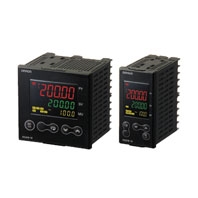
Advanced Digital Temperature Controller

E5AN-H / E5EN-H (96 x 96 mm and 48 x 96 mm)

E5AN-H / E5EN-H (96 x 96 mm and 48 x 96 mm)

A New High-performance Controller: High Resolution, High Speed, and High Input Accuracy. Logic Operations and Preventive Maintenance Function. Plus Infrared Port on Front Panel.

Primary Contents


Ratings

Power supply voltageNo D in model number: 100 to 240 VAC, 50/60 Hz
D in model number: 24 VAC, 50/60 Hz; 24 VDC
Operating voltage range85% to 110% of rated supply voltage
Power consumption100 to 240 VAC: 12 VA
24 VAC/VDC: 8.5 VA (24 VAC)/5.5 W (24 VDC)
Sensor inputAny of the following can be selected.
Thermocouple: K, J, T, E, L, U, N, R, S, B, W, or PL II
Platinum resistance thermometer: Pt100 or JPt100
Current input: 4 to 20 mA or 0 to 20 mA
Voltage input: 1 to 5 V, 0 to 5 V, or 0 to 10 V
Input impedanceCurrent input: 150 Ω max., Voltage input: 1 M Ω min. (Use a 1:1 connection when connecting the ES2-HB.)
Control methodON/OFF control or 2-PID control (with auto-tuning)
Control
output
Relay outputOutput Unit (Install the Output Unit (sold separately).)
Voltage output
(for driving SSR)
Current output
Linear voltage
output
Built-in SSR output75 to 250 VAC, 1 A (resistive load)
Relay output for
position-
proportional control
Relay output: Open and close: SPST-NO, 250 VAC, 1 A (including in-rush current), electrical life: 100,000 operations min.
Potentiometer input: Must be between 100 Ω and 2.5 k Ω for maximum open position.
Auxiliary
output
Number of outputs2 or 3 max.
Output
specifications
Relay output: SPST-NO, 250 VAC, 3 A (resistive load), electrical life: 100,000 operations, minimum applicable load: 5 V, 10 mA
Event
input
Number of outputs2 or 4 (with an E53-AKB)
External contact
input specifications
Contact input: ON: 1 k Ω max., OFF: 100 k Ω min.
Non-contact input: ON: Residual voltage: 1.5 V max., OFF: Leakage current: 0.1 mA max.
Current flow: Approx. 7 mA per contact
Logic
operations
Number of
operations
8 max.
OperationsLogic operation:
Any of the following four patterns can be selected. The input status may be inverted.
(A and B) or (C and D), (A or C) and (B or D), A or B or C or D, A and B and C and D (A, B, C, and D are four inputs.)
Delay:
ON delay or OFF delay for the results of the logic operation given above.
Setting time: 0 to 9999 s or 0 to 9999 min
Output inversion:
Possible
OutputOne work bit per operation
Work bit
assignment
Any of The following can be assigned to up to eight work bits (logic operation results): Event input operations, auxiliary outputs, or control outputs.
Transfer
outputs
Number of outputs1 max. (Depends on model. Models with transfer output (F in model number)
Output
specifications
Current output: 4 to 20 mA DC, Load: 600 Ω max., Resolution at 4 to 20 mA: Approx. 10,000
RSP
input
Number of inputs1
Signal typeCurrent input: 4 to 20 mA (input impedance: 150 Ω ± 10%)
Analog input scalingScaling of signal to engineering units (EU)
- 19,999 to 30,000 (display: 30,000 max.)
Accuracy( ± 0.2% of FS) ± 1 digit max.
Input sampling
period
60 ms
Setting methodSet digitally using keys on the front panel or by using the RSP input.
Indication method11-segment digital display and individual indicators (7-segments displays also possible)
Character height: E5AN-H: PV: 15.8 mm, SV: 9.5 mm, MV: 6.8 mm; E5EN-H: PV: 11.8 mm, SV: 8.1 mm, MV: 5.8 mm
Content of 3-level display: PV/SV/MV, PV/SV/Bank No., or soak time remain
Number of digits: 5 for PV and SV, 4 for MV
Bank switchingSupported (number of banks: 8)
Local SP, alarm settings, PID sets (PID constants, MV upper limit, MV lower limit, etc.)
Other functionsManual output, heating/cooling control, loop burnout alarm, SP ramp, other alarm functions, heater burnout detection, 40% AT, 100% AT, MV limiter, input digital filter, self-tuning, temperature input shift, run/stop, protection functions, control output ON/OFF counter, extraction of square root, MV change rate limit, PV/SV status display, logic operations, automatic cooling coefficient adjustment
Ambient operating temperature-10 to 55 ° C (with no condensation or icing), for 3-year warranty: -10 to 50 ° C
Ambient operating humidity25% to 85%
Storage temperature-25 to 65 ° C (with no condensation or icing)

Input Ranges

Thermocouple/Platinum Resistance Thermometer (Fully Universal Inputs)

E5AN-H/E5EN-H_Spec1

Shaded settings are the default settings.
The applicable standards for the input types are as follows:
K, J, T, E, N, R, S, B: JIS C 1602-1995, IEC 584-1
L: Fe-CuNi, DIN 43710-1985
U: Cu-CuNi, DIN 43710-1985
W: W5Re/W26Re, ASTM E988-1990
JPt100: JIS C 1604-1989, JIS C 1606-1989
Pt100: JIS C 1604-1997, IEC 751
PL II: According to Platinel II electromotive force charts from BASF (previously Engelhard)

Alarm Outputs

Each alarm can be independently set to one of the following 15 alarm types. The default is 2: Upper limit.
Auxiliary outputs are allocated for alarms. ON delays and OFF delays (0 to 999 s) can also be specified.

Note:For models with heater burnout, SSR failure, and heater overcurrent detection, alarm 1 will be an OR output of the alarm selected from the following alarm types and the alarms for heater burnout, SSR failure, and heater overcurrent. To output only a heater burnout alarm, SSR failure alarm, and heater overcurrent alarm for alarm 1, set the alarm type to 0 (i.e., no alarm function).

Set
value
Alarm typeAlarm output operationDescription of function
When alarm value
X is positive
When alarm value
X is negative
0Alarm function OFFOutput OFFNo alarm
1Upper- and lower-limit *1
*2Set the deviation in the set point by setting the
alarm upper limit (H) and alarm lower limit (L).
2Upper-limit
Set the upward deviation in the set point by
setting the alarm value (X).
3Lower-limit
Set the downward deviation in the set point by
setting the alarm value (X).
4Upper- and lower-limit range
*1
*3Set the deviation in the set point by setting the
alarm upper limit (H) and alarm lower limit (L).
5Upper- and lower-limit with
standby sequence *1
*5
*4A standby sequence is added to the upper- and
lower-limit alarm (1). *7
6Upper-limit with standby
sequence
A standby sequence is added to the upper-limit
alarm (2). *7
7Lower-limit with standby
sequence
A standby sequence is added to the lower-limit
alarm (3). *7
8Absolute-value upper-limit
The alarm will turn ON if the process value is
larger than the alarm value (X) regardless of
the set point.
9Absolute-value lower-limit
The alarm will turn ON if the process value is
smaller than the alarm value (X) regardless of
the set point.
10Absolute-value upper-limit
with standby sequence
A standby sequence is added to the absolute-value
upper-limit alarm (8). *7
11Absolute-value lower-limit
with standby sequence
A standby sequence is added to the absolute-value
lower-limit alarm (9). *7
12LBA (alarm 1 type only)---Refer to Data Sheet.
13PV change rate alarm---Refer to Data Sheet.
14RSP absolute value upper
limit *6
The alarm turns ON when the remote SP (RSP)
is larger than the alarm value (X). This alarm
functions in both Local SP and Remote SP Modes.
15RSP absolute value lower
limit *6
The alarm turns ON when the remote SP (RSP)
is smaller than the alarm value (X). This alarm
functions in both Local SP and Remote SP Modes.

*1.With set values 1, 4 and 5, the upper and lower limit values can be set independently for each alarm type, and are expressed as "L" and "H."

*2.Set value: 1, Upper- and lower-limit alarm

E5AN-H/E5EN-H_Spec2

*3.Set value: 4, Upper- and lower-limit range

E5AN-H/E5EN-H_Spec3

*4.Set value: 5, Upper- and lower-limit with standby sequence
For Upper- and Lower-Limit Alarm Described Above
Case 1 and 2
Always OFF when the upper-limit and lower-limit hysteresis overlaps.
Case 3: Always OFF

*5.Set value: 5, Upper- and lower-limit with standby sequence Always OFF when the upper-limit and lower-limit hysteresis overlaps.

*6.Displayed when there is a remote SP input.

*7.Refer to Data Sheet.

Characteristics

Indication accuracyThermocouple: ( ± 0.1% of indicated value or ± 1°C, whichever is greater) ± 1 digit max. *1
Platinum resistance thermometer: ( ± 0.1% of indicated value or ± 0.5°C, whichever is greater) ± 1 digit max.
Analog input: ± 0.1% FS ± 1 digit max.
CT input: ± 5% FS ± 1 digit max.
Potentiometer input: ±5% FS ±1 digit max.
Transfer output accuracy± 0.3% FS max.
Influence of temperature
*2
Thermocouple input (R, S, B, W, PL II): ( ± 1% of PV or ± 10°C, whichever is greater) ± 1 digit max.
Other thermocouple input: ( ± 1% of PV or ± 4°C, whichever is greater) ± 1 digit max. *3
Platinum resistance thermometer: ( ± 1% of PV or ± 2°C, whichever is greater) ± 1 digit max.
Analog input: ( ± 1%FS) ± 1 digit max.
Influence of voltage *2
Input sampling period60 ms
HysteresisTemperature input: 0.1 to 3240.0°C or °F (in units of 0.1°C or °F)
Analog input: 0.01% to 99.99% FS (in units of 0.01% FS)
Proportional band (P)Temperature input: 0.1 to 3240.0°C or °F (in units of 0.1°C or °F)
Analog input: 0.1% to 999.9% FS (in units of 0.1% FS)
Integral time (I)0.0 to 3240.0 s (in units of 0.1 s)
Derivative time (D)0.0 to 3240.0 s (in units of 0.1 s)
Control period0.5, 1 to 99 s (in units of 1 s)
Manual reset value0.0 to 100.0% (in units of 0.1%)
Alarm setting range-19999 to 32400 (decimal point position depends on input type)
Affect of signal source
resistance
Thermocouple: 0.1°C/Ω max. (100 Ω max.)
Platinum resistance thermometer: 0.1°C/Ω max. (10 Ω max.)
Insulation resistance20 MΩ min. (at 500 VDC)
Dielectric strength2,300 VAC, 50 or 60 Hz for 1 min (between terminals with different charge)
Vibration
resistance
Malfunction10 to 55 Hz, 20 m/s2 for 10 min each in X, Y, and Z directions
Destruction10 to 55 Hz, 0.75-mm single amplitude for 2 hrs each in X, Y, and Z directions
Shock
resistance
Malfunction100 m/s2, 3 times each in X, Y, and Z directions
Destruction300 m/s2, 3 times each in X, Y, and Z directions
WeightE5AN-HController: Approx. 310 g, Mounting Bracket: Approx. 100 g
E5EN-HController: Approx. 260 g, Mounting Bracket: Approx. 100 g
Degree of protectionFront panel: IP66, Rear case: IP20, Terminals: IP00
Memory protectionNon-volatile memory (number of writes: 1,000,000 times)
Setup ToolCX-Thermo version 4.0 or higher
Setup Tool portProvided on the bottom of the E5AN-H and E5EN-H.
An E58-CIFQ1 USB-Serial Conversion Cable is required to connect the computer to the E5AN-H and E5EN-H.
Provided on the front of the E5AN-H and E5EN-H. An E58-CIFIR USB-infrared Conversion Cable is required
to connect the computer to the E5AN-H or E5EN-H. *4
StandardsApproved
standards
UL 61010-1, CSA C22.2 No. 1010-1
Conformed
standards
EN 61010-1 (IEC 61010-1): Pollution level 2, overcurrent category II, Lloyd's standards
EMCEMI: EN 61326
Radiated Interference Electromagnetic Field Strength: EN 55011 Group 1, class A
Noise Terminal Voltage: EN 55011 Group 1, class A
EMS: EN 61326
ESD Immunity: EN 61000-4-2
Electromagnetic Field Immunity: EN 61000-4-3
Burst Noise Immunity: EN 61000-4-4
Conducted Disturbance Immunity: EN 61000-4-6
Surge Immunity: EN 61000-4-5
Power Frequency Magnetic Field Immunity: EN 61000-4-8
Voltage Dip/Interrupting Immunity: EN 61000-4-11

*1.The indication accuracy of K thermocouples in the −200 to 1300°C range, T and N thermocouples at a temperature of −100°C max., and U and L thermocouples at any temperatures is ±2°C ±1 digit max. The indication accuracy of the B thermocouple at a temperature of 400°C max. is not specified. The indication accuracy of B thermocouples in the 400 to 800°C range is ±3°C max. The indication accuracy of the R and S thermocouples at a temperature of 200°C max. is ±3°C ±1 digit max. The indication accuracy of W thermocouples is ±0.3% of PV or ±3°C, whichever is greater, ±1 digit max.
The indication accuracy of PL II thermocouples is ±0.3% of PV or ±2°C, whichever is greater, ±1 digit max.

*2.Ambient temperature: −10°C to 23°C to 55°C, Voltage range: −15% to 10% of rated voltage

*3.K thermocouple at −100°C max.: ±10°C max.

*4.External communications (RS-232C, RS-485, or RS-422) and cable communications for the Setup Tool can be used at the same time.

USB-Serial Conversion Cable

Applicable OSWindows 2000, XP, or Vista
Applicable softwareCX-Thermo version 4 or higher
Applicable modelsE5AN/E5EN/E5CN/E5CN-U/E5AN-H/E5EN-H/E5CN-H/E5GN
USB interface standardConforms to USB Specification 1.1.
DTE speed38400 bps
Connector specificationsComputer: USB (type A plug)
Temperature Controller: Setup Tool port (on bottom of Controller)
Power supplyBus power (Supplied from USB host controller.)
Power supply voltage5 VDC
Current consumption70 mA
Ambient operating temperature0 to 55°C (with no condensation or icing)
Ambient operating humidity10% to 80%
Storage temperature- 20 to 60°C (with no condensation or icing)
Storage humidity10% to 80%
Altitude2,000 m max.
WeightApprox. 100 g

Note:A driver must be installed in the personal computer.

Communications Specifications

Transmission line connection methodRS-485, RS-422: Multipoint
RS-232C: Point-to-point
CommunicationsRS-485 (two-wire, half duplex)
RS-422 (four-wire, half duplex) or RS-232C
Synchronization methodStart-stop synchronization
ProtocolCompoWay/F, SYSWAY, or Modbus
Baud rate1200, 2400, 4800, 9600, 19200, 38400, or 57600 bps
Transmission codeASCII (CompoWay/F, SYSWAY)
RTU (Modbus)
Data bit length *7 or 8 bits
Stop bit length *1 or 2 bits
Error detectionVertical parity (none, even, odd)
Frame check sequence (FCS) with SYSWAY
Block check character (BCC) with CompoWay/F or CRC-16 Modbus
Flow controlNone
InterfaceRS-485, RS-422, or RS-232C
Retry functionNone
Communications buffer217 bytes
Communications response wait time0 to 99 ms
Default: 20 ms

*The baud rate, data bit length, stop bit length, and vertical parity can be individually set using the Communications Setting Level.

Current Transformer (Order Separately)
Ratings

Dielectric strength1,000 VAC for 1 min
Vibration resistance50 Hz, 98 m/s2
WeightE54-CT1: Approx. 11.5 g, E54-CT3: Approx. 50 g
Accessories (E54-CT3 only)Armatures (2)
Plugs (2)

USB-Infrared Conversion Cable

Applicable OSWindows 2000, XP, or Vista
Applicable softwareCX-Thermo version 4.0 or higher
Applicable modelsE5AN-H/E5EN-H
USB interface standardConforms to USB Specification 1.1.
DTE speed38400 bps
Connector specificationsComputer: USB (type A plug)
Temperature Controller: Infrared port (on front of Controller)
Power supplyBus power (Supplied from USB host controller.)
Power supply voltage5 VDC
Current consumption80 mA
Ambient operating temperature0 to 55°C (with no condensation or icing)
Ambient operating humidity10% to 80%
Storage temperature- 20 to 60°C (with no condensation or icing)
Storage humidity10% to 80%
Altitude2,000 m max.
WeightApprox. 130 g (with mounting adaptor)

Note:A driver must be installed in the personal computer.

Heater Burnout Alarms, SSR Failure Alarms, and Heater Overcurrent Alarms

CT input
(for heater current detection)
Models with detection for single-phase heaters: One input
Models with detection for single-phase or three-phase heaters: Two inputs
Maximum heater current50 A AC
Input current indication accuracy±5% FS ±1 digit max.
Heater burnout alarm setting range *10.1 to 49.9 A (in units of 0.1 A)
Minimum detection ON time: 100 ms
SSR failure alarm setting range *20.1 to 49.9 A (in units of 0.1 A)
Minimum detection OFF time: 100 ms
Heater overcurrent alarm setting range *30.1 to 49.9 A (in units of 0.1 A)
Minimum detection ON time: 100 ms

*1.For heater burnout alarms, the heater current will be measured when the control output is ON, and the output assigned to the alarm 1 function will turn ON if the heater current is lower than the set value (i.e., heater burnout detection current value).

*2.For SSR failure alarms, the heater current will be measured when the control output is OFF, and the output assigned to the alarm 1 function will turn ON if the heater current is higher than the set value (i.e., SSR failure detection current value).

*3.For heater overcurrent alarms, the heater current will be measured when the control output is ON, and the output assigned to the alarm 1 function will turn ON if the heater current is higher than the set value (i.e., heater overcurrent detection current value).

Electrical Life Expectancy Curve for Relays (Reference Values)

E5AN-H/E5EN-H_Spec4

SSR Outputs (OUT1/OUT2) Ratings

Rated load voltage: 75 to 250 VAC
Rated load current: 1 A (resistive load)

Note:

1.The load current must be within the derating curve.

2.There is no zero-cross function.

Derating Curve for SSR Outputs (Reference Values)

E5AN-H/E5EN-H_Spec5

Condition A: SSR outputs 100% ON
Condition B: SSR outputs 50% ON with 2-s control cycle

Caution: In the interenst of product improvement, specifications are subject to change without notice.