
IT-OT Integration: The Key to Manufacturing DX
Even after introducing systems to promote DX, operations often continue to rely on experience and intuition, resulting in dependency on specific individuals. In addition, the lack of standardized equipment and production data formats often leads to manual processing and aggregation, increasing workload and causing input errors. Many manufacturing sites also face issues in obtaining data from aging equipment or effectively utilizing the data that can be collected.
Why, then, is smart factory transformation not progressing as expected?
One reason is the disconnect between IT (executive management) and OT (the field). This disconnect prevents organizations from fully realizing the value of data and can hinder DX initiatives.
IT-OT integration is essential in order to eliminate this divide and transform data into a true business asset.
This article explains why the IT-OT divide occurs and how IT-OT integration can help solve challenges facing manufacturers.
What are IT and OT?
IT and OT have evolved with entirely different objectives and backgrounds. To understand IT-OT integration, it is essential to first understand the objectives and backgrounds of both IT and OT. The reasons why cultural conflicts often arise between departments can also be traced back to these fundamental differences in roles.
What is IT?
The primary role of IT (information technology) is the management and utilization of information assets.
Typical examples include ERP (enterprise resource planning) systems, which centrally manage corporate resources, and SCM (supply chain management) systems, which optimize supply chains. IT is primarily aimed at improving operational efficiency and supporting decision-making.
What is OT?
The primary role of OT (operational technology) is the control and operation of physical equipment.
In manufacturing environments, systems such as PLCs (programmable logic controllers) and SCADA (supervisory control and data acquisition systems) are used to control machinery and robots. OT places particular emphasis on stable equipment operation and requires high levels of real-time performance, safety, and reliable execution of predefined actions.
Differences between IT and OT
IT and OT differ significantly in terms of objectives, management targets, and priorities. The characteristics of each are summarized below.
| IT (information technology) | OT (operational technology) | |
|---|---|---|
| Primary objective | Operational efficiency, decision-making support, and information management | Stable equipment operation, productivity improvement, and control of physical processes |
| Managed assets | Data, information, networks, and servers | Production equipment, machinery, sensors, and control devices |
| Key priorities | Confidentiality, integrity, and availability (information security) | Availability, safety, and real-time performance (OT security) |
| Lifecycle | Approximately 3 to 5 years (short) | Approximately 10 to 30 years (long) |
| Communication protocols | Standard protocols (TCP/IP, HTTP, etc.) | Industrial protocols (EtherNet/IP, EtherCAT, DeviceNet, Modbus) |
Because IT focuses on data utilization and business optimization, systems are typically updated every few years, with active adoption of open communication technologies and new innovations. OT, on the other hand, prioritizes stable operation of production equipment, resulting in less frequent system updates and the continued use of industry-specific communication protocols and specialized technologies.
These differences in technical assumptions and priorities are one of the factors underlying the divide between IT and OT departments.
Issues hindering DX in manufacturing
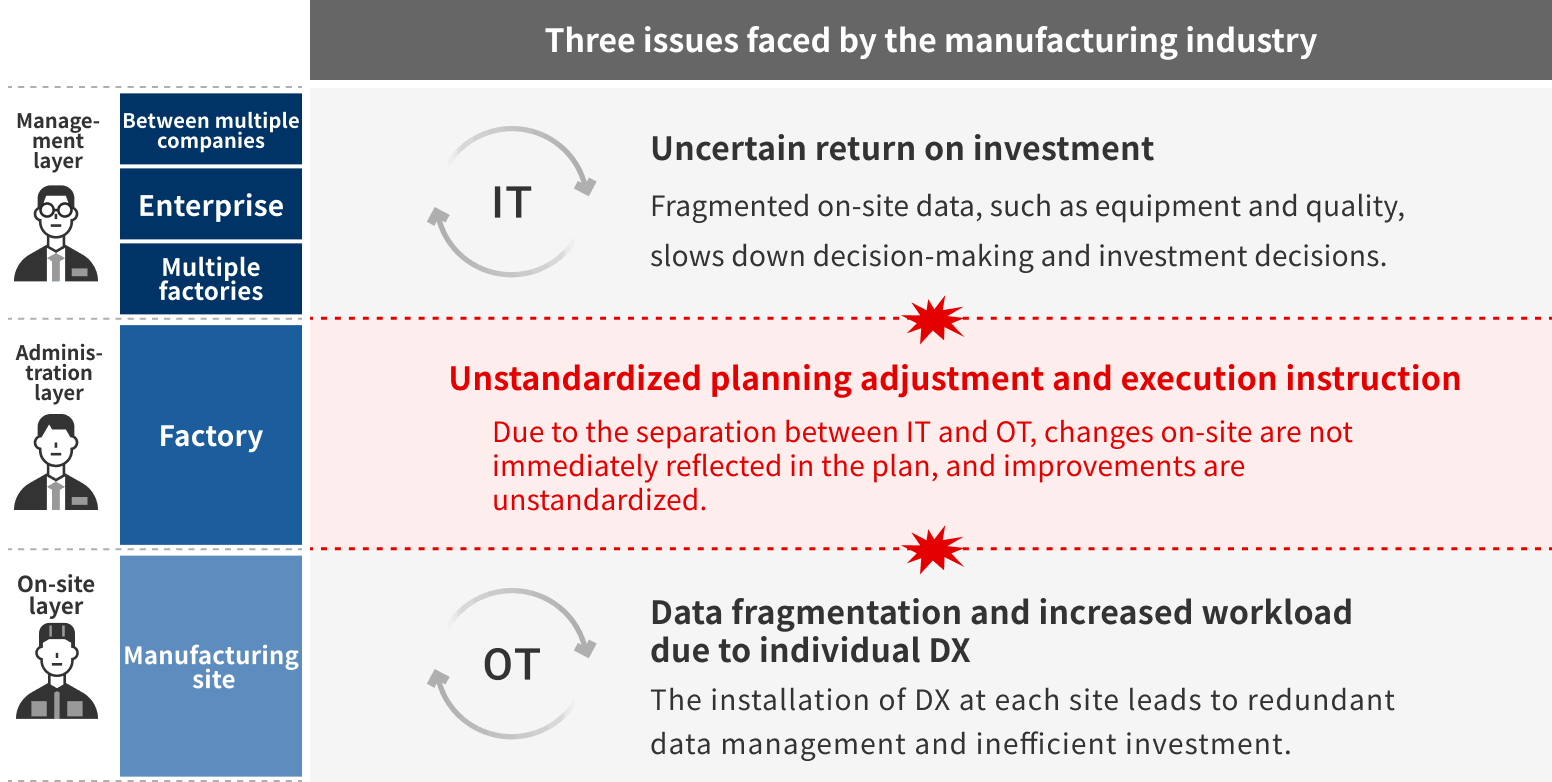
The divide between IT and OT creates issues at every level of manufacturing organizations, from the on-site layer to the executive layer. When promoting DX, these issues can be viewed from three perspectives.
Executive layer issuesInability to access real-time data for management decision-making
In the executive layer (IT) level, siloed systems and data across departments delay visibility into business conditions and investment decisions. Manual KPI and P&L aggregation requires significant time and effort, making it difficult to respond quickly to rising operating costs and supply chain issues. As a result, investment decisions are often delayed.
In addition, because core systems operate on global standards and cannot easily be modified, it is difficult to obtain visibility into equipment operating conditions and quality information, making it challenging to quantitatively assess business impact and return on investment.
Management layer issuesDelayed decision-making and missed opportunities caused by non-standardized data and operating standards
In the management (edge) layer, differences in data and operating standards between IT and OT require significant effort for information organization and utilization.
In addition, differences in equipment usage and data aggregation methods between sites make it difficult to compare production conditions side by side, often resulting in lengthy analysis processes that must be completed before overall optimization can be achieved.
On-site layer issuesLimitations on data acquisition and utilization caused by aging equipment
In the on-site (OT) layer, legacy systems and aging equipment that have been in operation for many years present major obstacles. As equipment has undergone specific optimization over time, factories often contain a mix of old and new equipment from different manufacturers.
As a result, communication standards and data formats differ from one machine to another, making data centralization difficult. Even when data can be collected from newer production lines, inconsistencies in data formats across the factory prevent effective analysis and utilization for overall optimization.
What can be achieved through IT-OT integration?
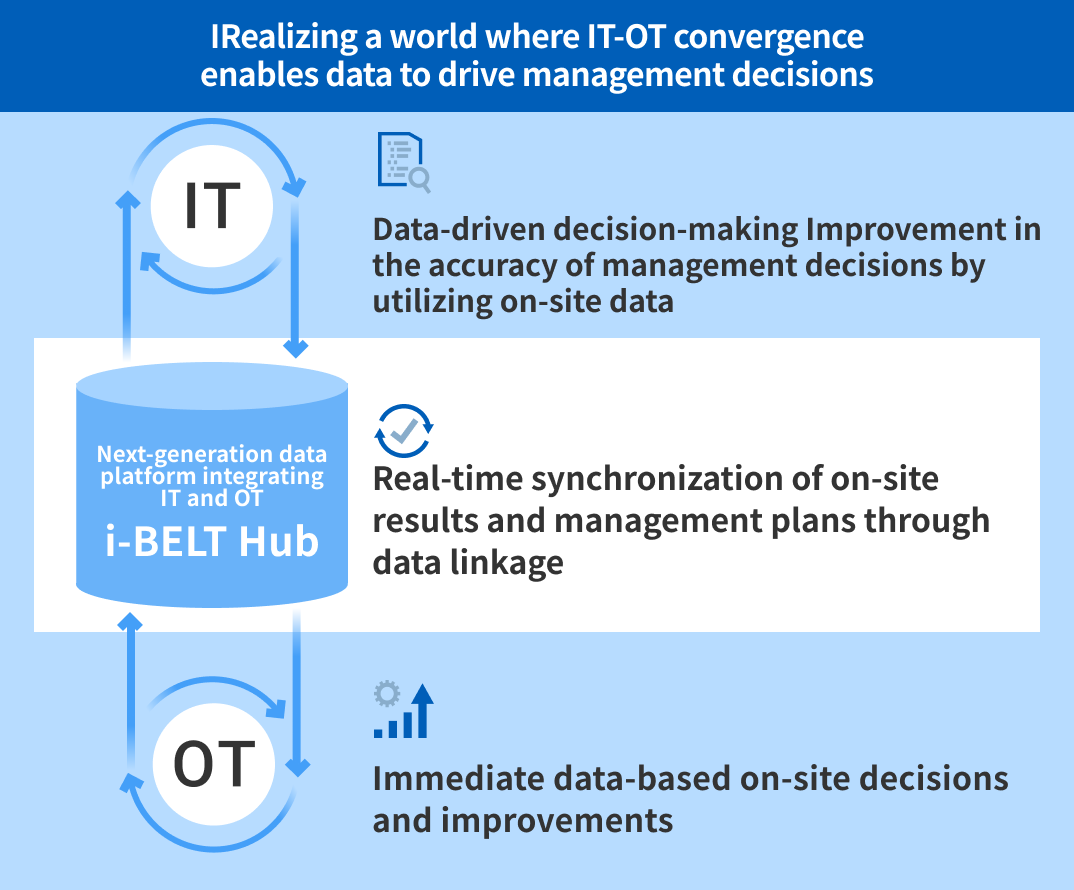
Connecting fragmented IT and OT is essential for advancing DX in manufacturing. By integrating management (IT) data and field (OT) data, which have traditionally been managed separately, organizations can address issues faced by the field, management, and executive layers while creating new value.
Executive layerRealizing data-driven executive decision-making
By integrating real-time on-site data from the OT domain with management and financial data from the IT domain, factory operating conditions and yields, and cost generation can be monitored in real time through dashboards.
This also enables faster, data-driven decision-making and improves the accuracy of management decision-making.
Management layerVisualize the entire supply chain and build a production system resilient to change
Visibility across the entire supply chain can be achieved by integrating booking information and demand forecasts from IT systems with real-time production actuals and equipment operating data from OT systems. Even when sudden demand fluctuations or component supply delays occur, production plans can be optimized immediately based on data, preventing inventory shortages and excess stock. This enables the creation of a resilient production system capable of responding flexibly to highly uncertain market conditions.
On-site layerDigitize field operations to achieve work standardization and stable quality
IT-OT integration enables detailed digital capture of operating conditions and skilled worker know-how that was previously concealed.
By integrating and analyzing fragmented equipment data in a common format, tacit work procedures become visible.
This reduces dependence on unstandardized work and enables standardized operations that anyone can perform at the same level while eliminating quality variations.
Connecting management decision-making and operational improvements through IT-OT integration
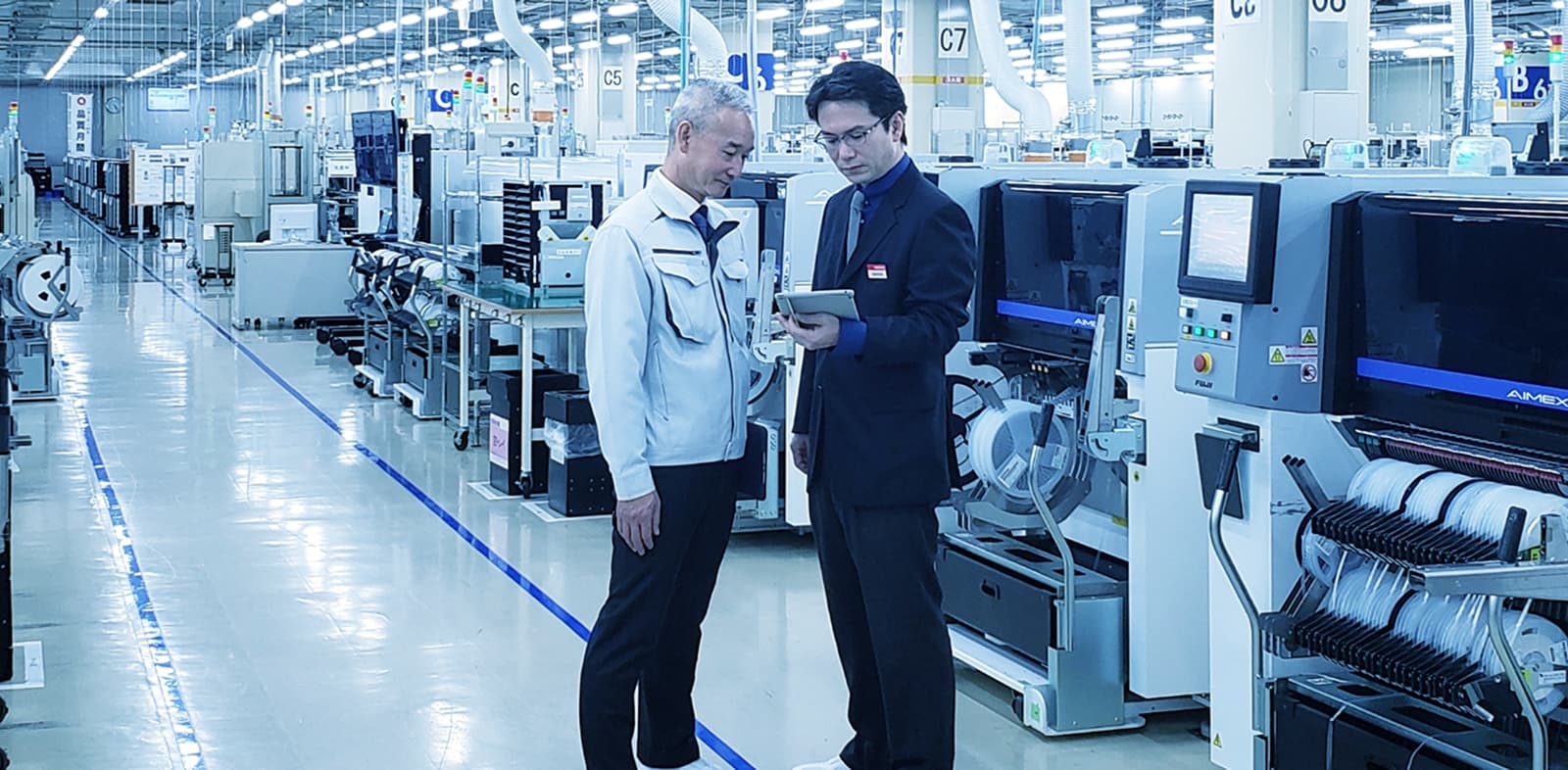
IT-OT integration cannot be achieved simply by connecting networks. It is equally important to bridge the differing perspectives and cultures of IT, which prioritizes information assets and security, and OT, which prioritizes stable equipment operation and safety.
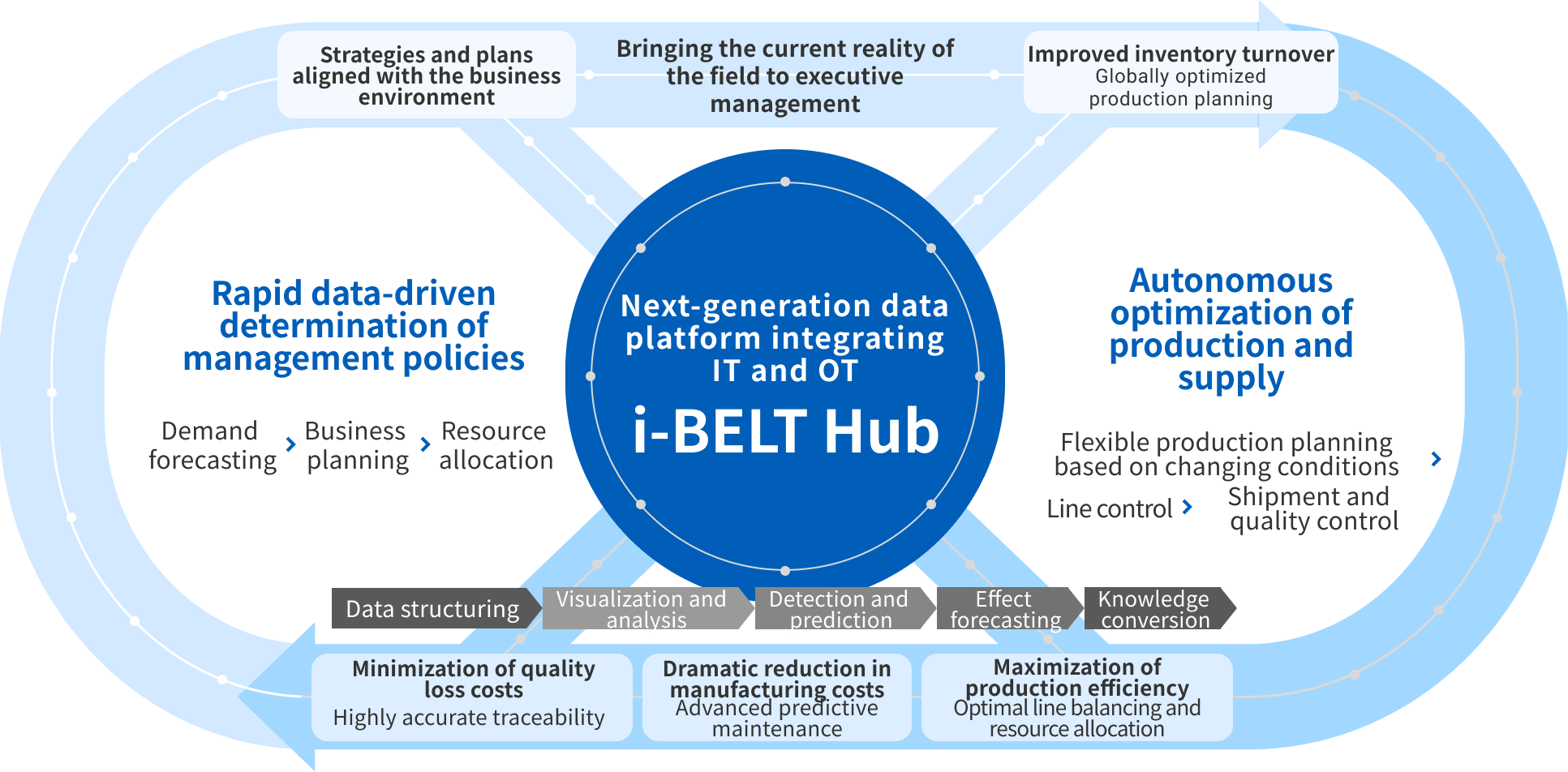
With OMRON’s i-BELT data solution, the next-generation data platform i-BELT Hub integrates IT and OT, collecting and integrating field data such as equipment operating conditions, quality information, and production actuals and then organizing and visualizing it for use in management decision-making. This solution enables previously underutilized on-site data to be transformed into meaningful information.
In addition, OMRON’s deep process understanding and field expertise based on the Three Reality Philosophy enable data to be organized in a highly usable form, creating a data cycle that links field actions with management indicators. This data cycle makes it possible to understand what is happening now in the field in real time and rapidly reflect management policies back into operations.
As a result, it connects a seamless, uninterrupted production system with a fast and efficient management cycle, enabling manufacturers to build production systems capable of responding flexibly to rapidly changing market conditions.
By linking a smooth, bottleneck-free production system with a fast, efficient management cycle,
we enable ROIC management that continues to maximize cash flow, even in rapidly changing market environments
Footnote:i-BELT is a registered trademark of OMRON Corporation. All other company names, product names, and related names mentioned herein are the registered trademarks or trademarks of their respective owners.
Some product photographs and illustrations used on this website include images for illustrative purposes and may differ from the actual products. The content of this website is subject to change without prior notice for improvement purposes.